

When a rivalry spans three decades, the answer is no longer "which one is better." The question is: which one fits the life you're actually living right now?
The 2026 Toyota RAV4 arrives as a full redesign — all-hybrid, no gas-only trims. The Honda CR-V stays the course with a mid-cycle refresh, keeping its 1.5L turbo as an entry option while continuing to offer a hybrid. Both are competent, reliable, and easy to resell. But if you're deciding for a family, four dimensions deserve a closer look.
1. Cargo & Cabin Space: Paper Numbers vs. Daily Reality
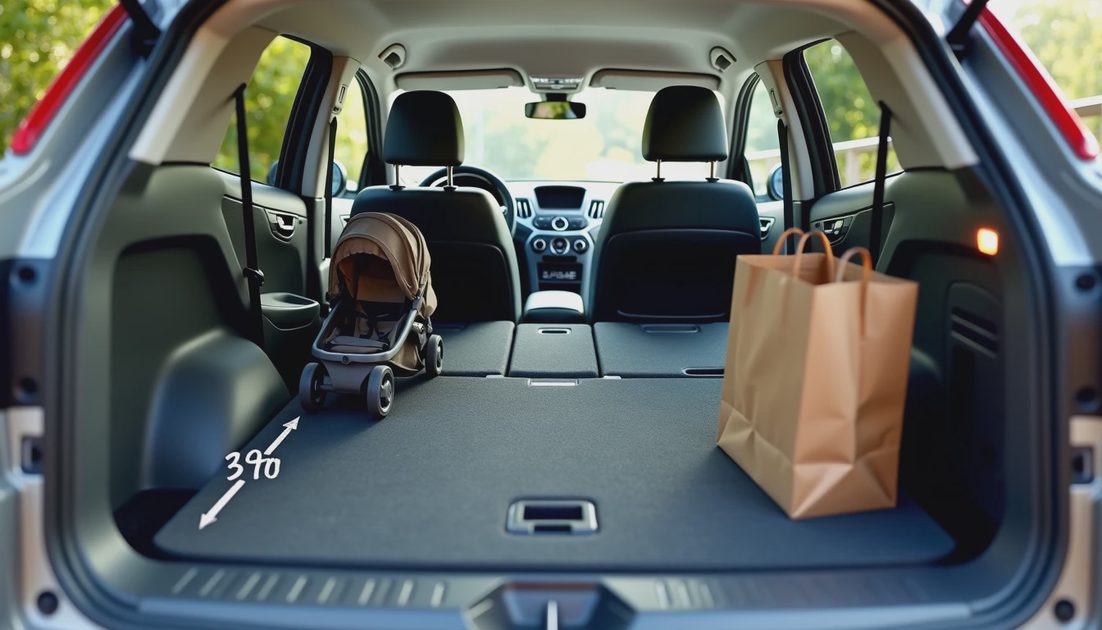
Hard numbers first. The CR-V offers 39.3 cubic feet behind the rear seats in gas form, expanding to 76.5 with seats folded. The hybrid version drops to 36.3 cubic feet due to battery packaging. The RAV4 is consistent across the lineup: 37.8 cubic feet (seats up) and 70.4 (seats down).
On paper, the gas CR-V wins. But three under-discussed details change the picture.
First, when you buy the hybrid — and the 2026 RAV4 is hybrid-only — the CR-V's cargo advantage largely disappears. At 36.3 cubic feet, the CR-V Hybrid actually trails the RAV4 by 1.5 cubes. The "CR-V has a bigger trunk" assumption no longer holds in a hybrid-to-hybrid comparison.
Second, the spare tire. The RAV4 keeps a spare across all trims. The CR-V Hybrid deletes it entirely in favor of a tire repair kit. When you're 40 miles from the nearest service station with kids in the back, a spare tire matters more than 1.5 cubic feet of extra cargo space.
Third, rear legroom is where the CR-V pulls ahead decisively. 41.0 inches in the CR-V versus 37.8 in the RAV4 — a 3.2-inch difference. U.S. News describes the CR-V's rear seat as "limo-like spacious." That's not exaggeration. If you regularly install child safety seats or carry adult passengers on long drives, the CR-V's rear cabin is meaningfully more comfortable. The RAV4 counters with smarter small-item storage — door pulls, center console, and dash nooks that swallow family clutter better. But for sheer passenger space, the CR-V wins the back seat.
Space verdict: If you're buying a hybrid SUV and mostly drive in urban or suburban settings, the RAV4's spare tire and squared-off cargo area are the more practical package. If you regularly carry adults in the back seat, the CR-V's legroom advantage is something you'll feel every single day.
2. Safety: Gaps in the Data Are Themselves a Data Point
We need to be upfront about uncertainty here.
The 2026 RAV4 is an all-new platform. Neither IIHS nor NHTSA has published crash-test results for it yet. Meanwhile, the CR-V recently received a "Poor" rating for rear-passenger chest protection in IIHS's updated moderate-overlap front test — a result that has drawn significant attention in the automotive press.
What does this mean for a buyer right now? The RAV4's passive-safety performance on the new platform is unverified. The CR-V has a demonstrated weakness under the latest, more stringent testing protocol. This brings us to a core DriveByNumbers principle:
Don't assume that two popular Japanese SUVs are equally safe just because both have strong reputations. Incomplete data is itself a decision variable. If a top safety rating is non-negotiable — say, this is the only vehicle you use to transport your kids — making a decision before RAV4 crash scores are published means accepting an information gap. You can wait. You can also look at the previous-generation track record: both vehicles earned IIHS Top Safety Pick ratings under the older testing regime.
Safety verdict: The CR-V's "Poor" rear-passenger score is a known concern. The RAV4's safety is an unknown. Neither situation is ideal. If you must buy now and safety is your top priority, you may want to widen your comparison set — or wait for data.
3. Fuel Costs: Hybrid vs. Hybrid, Toyota Is Thriftier
Since the 2026 RAV4 is hybrid-only, the relevant comparison is hybrid-to-hybrid.
The RAV4 Hybrid is EPA-estimated at approximately 38-41 MPG combined (FWD/AWD). The CR-V Hybrid comes in at roughly 35-37 MPG combined (AWD). The gap isn't dramatic, but it's real.
Let's translate that into dollars. At $3.50 per gallon and 12,000 miles per year:
RAV4 Hybrid (39 MPG combined average): roughly $1,077 per year
CR-V Hybrid (36 MPG combined average): roughly $1,167 per year
That's about $90 per year in the RAV4's favor, or $450 over five years. Not life-changing, but the RAV4 also holds a larger fuel tank (14.5 gallons vs. the CR-V Hybrid's 14.0), meaning slightly fewer fill-ups.
The CR-V does offer a gas-only 1.5L turbo that starts at a lower MSRP. But its combined fuel economy lands around 28-30 MPG, which translates to roughly $1,400 per year in fuel — a $1,400 per year in fuel — a $300-plus annual gap versus either hybrid. If you're tempted by the lower entry price of the gas CR-V, run the fuel math first.
Fuel-cost verdict: The RAV4 wins on efficiency, but not by a margin that should single-handedly swing your decision. The real lesson: buy the hybrid version of whichever vehicle you choose. The gas-only CR-V's fuel-cost penalty erases its upfront savings faster than most buyers expect.
4. Resale Value: Toyota's Grip Is Strong, but Honda Is Close
This is where the RAV4 has historically held an edge — and it's an edge that compounds.
Over the past five years, the RAV4 has consistently ranked among the top compact SUVs for retained value. Kelley Blue Book and J.D. Power residual-value data both place the RAV4 slightly ahead of the CR-V at the 36-month and 60-month marks. The gap typically sits at 2-4 percentage points of retained MSRP.
Why it matters: On a $34,000 SUV, a 3-percentage-point resale advantage at the five-year mark is worth roughly $1,000. That’s more than the five-year fuel-cost difference between the two hybrids.In other words, resale value may matter more to your wallet than the fuel-efficiency gap.
The CR-V isn't a depreciation disaster — it's still among the best in class. But Toyota's reputation for long-term durability, combined with the RAV4's broader hybrid-only lineup (which tends to hold value better than gas equivalents), gives it a structural advantage in the used market.
One caveat: the 2026 RAV4 is a first-year redesign. Historically, first-year models carry slightly more depreciation risk due to unproven reliability. This isn't a reason to avoid it, but it's worth watching as real-world ownership data accumulates.
Resale verdict: The RAV4 edges ahead. The margin isn't enormous, but over a typical five-to-seven-year ownership window, it's real money.
The Bottom Line
Dimension | Winner | Margin |
|---|---|---|
Cargo practicality (hybrid-to-hybrid) | RAV4 | Narrow — spare tire tips it |
Rear passenger space | CR-V | Decisive |
Safety (current data) | Neither — incomplete | Wait for RAV4 scores |
Fuel cost (hybrid-to-hybrid) | RAV4 | ~$90/year |
Resale value | RAV4 | ~2-4 percentage points |
Buy the RAV4 if: you're buying a hybrid, cargo practicality and a spare tire matter to your daily life, and long-term resale value is a priority. The 2026 redesign brings updated tech and a more efficient powertrain.
Buy the CR-V if: you regularly carry adult passengers or older kids in the back seat, rear legroom is non-negotiable, or you want to keep the option of a lower-entry-price gas model. Just budget for higher fuel costs if you skip the hybrid.
The question isn't whether either of these SUVs is good. Both are. The question is which one makes sense for the people who'll actually be sitting in it.