The 2026 Hyundai Tucson and 2026 Mazda CX-5 represent two fundamentally different answers to the same question: what should a compact SUV be? The Tucson packs more rear legroom, more cargo space, and a broader range of powertrains — including two hybrids — into a value-forward package. The redesigned CX-5 stretches its wheelbase by 4.5 inches for more interior room and doubles down on driving dynamics and upscale interior feel, though it drops the optional turbo engine entirely. One prioritizes comfort and practicality. The other prioritizes the experience behind the wheel. Here's how to decide which matters more in the daily grind of family life.
Space & Practicality: The Measurable Gap
Let's start with the dimension that affects every single drive: how well the vehicle accommodates the people and things you actually carry.
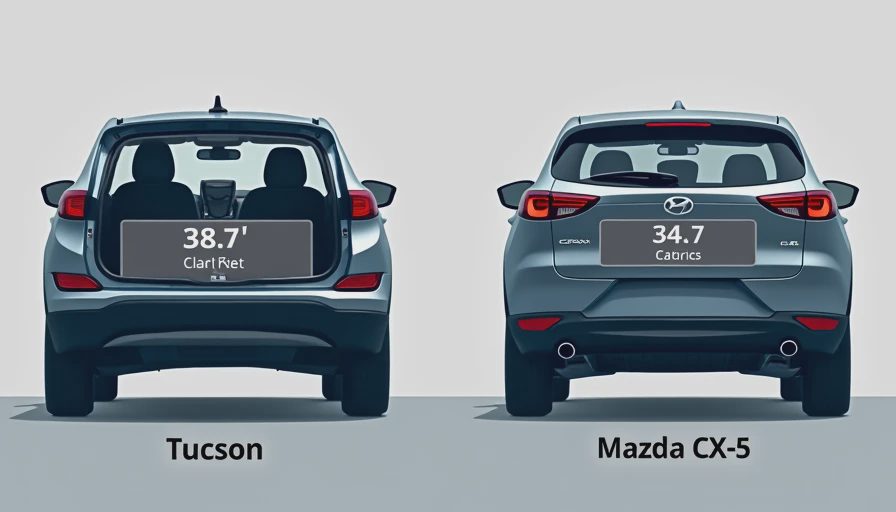
Cargo capacity tilts toward the Tucson. The Hyundai offers 38.7 cubic feet behind the rear seats and 74.8 cubic feet with them folded in gas form — the hybrid loses only a negligible fraction of that . The redesigned 2026 CX-5 makes meaningful gains over its predecessor, jumping to 34 cubic feet behind the rear seats and 67 cubic feet with them folded — up from 29 and 59 in the old model . That's a real improvement, and Mazda deserves credit for addressing the old CX-5's biggest weakness. But the gap to the Tucson is still roughly 5 cubic feet behind the second row.
That's the difference between fitting a full-size stroller lengthwise or having to angle it. It's noticeable on a Costco run. It's not deal-breaking, but it's measurable.
Rear-seat space is the Tucson's stronger card. The Hyundai offers 41.3 inches of rear legroom . Mazda hasn't published exact 2026 rear legroom figures yet, but even with the 4.5-inch wheelbase stretch, the CX-5's rear quarters are described as "increased" rather than class-leading . The pre-redesign CX-5 had 39.6 inches — adequate but unremarkable. If you're installing rear-facing child seats or regularly carrying adult passengers, the Tucson's advantage in this dimension is something you'll feel every day.
The practical verdict: The Tucson is the more spacious vehicle by objective measures. The CX-5's redesign closes the gap considerably, but doesn't erase it. If interior volume is a top priority, the Hyundai has the edge.
Powertrain & Fuel Economy: More Choices vs. One Refined Option
This is where the two vehicles diverge most sharply — and where the 2026 CX-5's redesign makes a controversial call.
The Tucson offers three powertrains:
2.5L gas: 187 hp, 25/33/28 MPG (FWD); 24/30/26 (AWD)
Hybrid: 231 hp combined, 36-38 MPG combined (varies by trim)
Plug-in Hybrid: 268 hp combined, 32 miles electric range, 35 MPG in hybrid mode
The CX-5 offers one powertrain:
2.5L gas: 187 hp (approx.), 24/30/26 MPG with cylinder deactivation
The previously available turbo engine is gone for 2026
A hybrid is promised for 2027, but it's not available yet
The CX-5's single-engine strategy is a gamble. The naturally aspirated 2.5L is smooth and adequate, but 26 MPG combined with AWD — the configuration most family buyers will choose — is unremarkable in a segment where the Tucson Hybrid delivers 36–38 MPG. The difference at 12,000 miles per year and $3.50/gallon is roughly $400 annually. Over five years, that's $2,000 in fuel savings the CX-5 simply can't match until its hybrid arrives.
However, the CX-5's six-speed automatic is widely praised for responsive tuning, and the lack of a turbo means one fewer expensive component to fail over a long ownership window. The Tucson's hybrid system is warrantied for 10 years/100,000 miles, which offsets some long-term risk , but the gas-only Tucson's 2.5L and eight-speed automatic don't have the same reputation for engagement as Mazda's powertrain.
The powertrain verdict: The Tucson gives you options, and the hybrid's fuel savings are real. The CX-5 gives you one refined choice that's pleasant but thirstier. If efficiency matters — and for most family buyers, it does — the Tucson wins. If you prefer a naturally aspirated engine with a well-tuned automatic and don't mind the fuel penalty, the CX-5 is adequate.
Safety: Both Perform, but IIHS Honors Differ
Both vehicles perform well in crash testing, but the IIHS award tally tells an interesting story.
The 2026 Hyundai Tucson earned a Top Safety Pick+ designation from the IIHS — the agency's highest honor . Mazda leads the industry in 2026 with eight TSP+ awards, and the CX-5 is notably absent from that list . The CX-30, CX-50, CX-70, and CX-90 all earned TSP+, but the CX-5 did not appear in the preliminary list .
This doesn't mean the CX-5 is unsafe. It likely means the redesigned 2026 model hasn't completed the full IIHS testing protocol yet — a common situation for a vehicle in its first model year after a major redesign. But for a family buyer making a decision right now, the Tucson has a verified, published safety rating from an independent agency, and the CX-5 does not. Data that doesn't exist yet is itself a decision variable.
Both vehicles include automatic emergency braking, lane departure warning, blind-spot monitoring, and rear cross-traffic alert as standard .
The safety verdict: The Tucson has the verified IIHS rating today. The CX-5's safety performance is likely strong given Mazda's track record, but "likely" isn't the same as "tested."
Resale Value: Mazda's Quiet Advantage
According to iSeeCars' depreciation analysis, the Mazda CX-5 holds its value better than the Hyundai Tucson over a five-year ownership window. The CX-5 depreciates approximately 42.4% over five years, while the Tucson loses about 45.9% — a 3.5-percentage-point advantage for the Mazda .
On a $32,000 vehicle, that gap is worth roughly $1,120 at resale. It’s not life-changing, but it’s real — and it partially offsets the Tucson’s fuel-economy advantage. If you plan to own for five years, the Tucson saves you more at the pump; the CX-5 returns more when you sell.
Mazda's higher resale value is consistent with its broader brand positioning: lower incentive spending, a reputation for reliability, and a more upscale interior that ages gracefully all contribute to stronger used-market demand. Hyundai has improved significantly in this area, but the data shows Mazda still holds the edge .
The resale verdict: The CX-5 wins on retained value, though not by a margin that should single-handedly swing your decision.
The Bottom Line
Dimension | Winner | Margin |
|---|---|---|
Cargo space | Tucson | Meaningful — ~5 cubic feet |
Rear legroom | Tucson | Noticeable for passengers |
Fuel economy | Tucson | Decisive if you buy the hybrid |
Driving feel | CX-5 | Subjective but widely praised |
Safety (current data) | Tucson | CX-5 not yet rated for 2026 |
Resale value | CX-5 | ~3.5 percentage points |
Buy the Tucson if: interior space, fuel efficiency, and a verified IIHS safety rating are your top priorities. The hybrid version, in particular, widens the gap on fuel costs to a degree the CX-5 can't answer until its own hybrid arrives in 2027.
Buy the CX-5 if: driving engagement matters more to you than outright cargo volume, you value interior refinement above all else, and you're willing to accept a fuel-economy penalty in exchange for a more rewarding daily experience behind the wheel. The 2026 redesign addresses the old model's space shortcomings without diluting what makes the CX-5 distinct.
The question isn't which one is better. It's whether the part of your day spent behind the wheel is something you want optimized for ease — or for engagement. Both are valid answers. Just know which one you're choosing.
Sources: CarBuzz (Tucson specs), Car and Driver (CX-5 redesign details), Ontario Hyundai (Tucson MPG figures), CW39/TestMiles (CX-5 pricing and fuel economy), IIHS (2026 Top Safety Pick list), Automotive World (Mazda TSP+ awards), iSeeCars (depreciation and resale data), Capital One Auto Navigator (Tucson trim and cargo details).