The Durability Flywheel: Why Toyota and Honda Win
Toyota and Honda don't win on resale because of brand mystique. They win because of a self-reinforcing cycle that's been spinning for decades.
It starts with reliability. Consumer Reports ranked Toyota first for predicted new-car reliability in 2026 with a score of 66 out of 100. Honda placed fourth . Those scores aren't abstractions — they translate directly into lower repair costs over a 100,000-mile ownership window, and used buyers know it. A five-year-old RAV4 or CR-V commands a premium because the buyer believes it'll run another 100,000 miles without major drama.
That reliability creates demand. High demand on the used market props up transaction prices. Higher transaction prices mean higher residual values. Higher residuals mean automakers don't need to pile cash on the hood to move new inventory. Limited incentive spending keeps new transaction prices high, which keeps used prices high. The flywheel feeds itself.
Toyota adds another layer: deliberately slow redesign cycles. The 4Runner went over a decade without a full redesign. The Tacoma followed a similar pattern. When a three-year-old Toyota looks essentially identical to a new one on the dealer lot, the used version doesn't feel outdated — and the price reflects that. The 2026 4Runner carries a 58.0% five-year retained value, the highest of any SUV on Kelley Blue Book's list .
Honda's approach is slightly different but equally effective. Honda engines have a reputation for lasting well over 200,000 miles with proper care, and the newer hybrid systems in the Accord and CR-V have developed a solid track record . The CR-V retains 53.2% of its value after five years, making it the top-ranked compact SUV for resale .
The practical takeaway: when you buy a Toyota or Honda, you're not just paying for the vehicle. You're buying into a used-market demand structure that returns a measurable percentage of your purchase price when you sell. That structure is the real asset — and it's taken competitors decades to replicate even a portion of it.
Where the Gap Is Narrowing
The 2026 data shows the Japanese dominance is no longer absolute. Several rivals have climbed within striking distance.
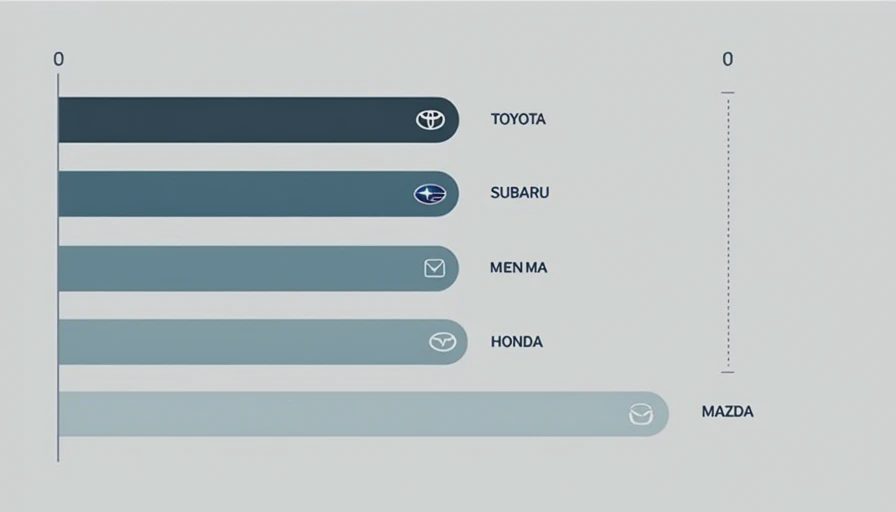
Subaru: Third place at 61.2%. Subaru now ranks third in five-year retained value, passing Honda . The Forester and Outback benefit from a buyer base that values all-wheel drive, durability, and a reputation for safety that rivals Toyota's. Subaru's strategy mirrors Toyota's in key respects: limited incentives, conservative styling updates, and a loyal owner base that feeds used demand. The Forester earned Top Safety Pick+ status for 2026, reinforcing the safety-first brand identity that props up resale.
Mazda: Moving upmarket, dragging resale with it. Mazda's five-year retained value sits at 59.7%, good for fifth place . The brand's shift toward premium interiors and refined driving dynamics — without the luxury-brand price tags that accelerate depreciation — has created a unique position in the used market. The CX-5 and CX-50 offer interiors that feel a class above their price points, and used buyers have noticed. Mazda also leads the industry in 2026 IIHS Top Safety Pick+ awards, which adds a safety credential to the value proposition.
Ram: The anomaly. Ram holds 59.5% five-year retained value, tied with Mazda — but Consumer Reports ranks it poorly for reliability . This is a reminder that resale value and reliability don't always align. Ram benefits from strong demand in the truck market, where American brands still command loyalty and dealer networks that Japanese trucks can't match. For family SUV buyers, this is less directly relevant — Ram doesn't compete in the compact or midsize SUV segments — but it illustrates that resale value is driven by demand, not just durability.
The Koreans are climbing — slowly. Hyundai and Kia don't yet appear in the top 10 for resale value, but their trajectory is worth watching. Kia's 10-year/100,000-mile powertrain warranty is the longest in the industry, and it transfers to subsequent owners. As more used Kia and Hyundai vehicles circulate with remaining warranty coverage, buyer confidence is building. The Telluride, in particular, has held resale values competitive with the Honda Pilot and Toyota Highlander in recent model years — though the 2027 redesign introduces uncertainty that won't resolve until real-world data accumulates.
The Tesla Wildcard
No discussion of resale value in 2026 is complete without acknowledging what's happening with Tesla.
The Tesla Model 3 now posts a three-year retained value of 61.4%, placing it ahead of most mainstream gasoline sedans — including some Toyota and Honda models . The Model X, despite its own depreciation challenges, still leads the EV segment at 61.7% . This is a structural shift: a battery-electric vehicle is now matching or beating internal-combustion stalwarts on retained value, something that would have been unthinkable three years ago.
The reasons are specific to Tesla. Over-the-air software updates extend the useful life of older vehicles in ways mechanical cars can't replicate. Battery health transparency — the ability to check degradation with precision — reduces buyer anxiety about the most expensive component. And Tesla's charging network remains a tangible asset that competitors are still racing to match.
For family SUV buyers, the Tesla data point matters indirectly. It signals that the used market is learning how to price EVs with greater confidence. As hybrid and electric SUVs from mainstream brands age into the used market, the resale dynamics that have historically favored Toyota and Honda may face pressure from a new direction — not just from rival gasoline brands, but from electrified vehicles whose depreciation curves are starting to flatten.
What This Means for a Family SUV Buyer
If you're shopping with resale value in mind, the 2026 data supports a few practical conclusions.
Toyota and Honda remain the safest bets. Toyota's 64.9% and Honda's 60.5% five-year retained value aren't accidents — they're the result of structural advantages that competitors haven't fully replicated . If you plan to own for three to seven years and resale value is a top priority, you're still best served by a RAV4, CR-V, 4Runner, or Grand Highlander.
Subaru and Mazda are the strongest alternatives. Subaru's 61.2% and Mazda's 59.7% mean these brands now hold value as well as or better than Honda in some segments . If a Forester or CX-50 fits your needs better than a CR-V, the resale penalty is shrinking to the point where other factors — cargo space, driving feel, safety ratings — should drive your decision.
Don't assume resale value and reliability are the same thing. Ram holds strong resale value despite below-average reliability scores . Some luxury brands — Mercedes-Benz and Lexus — appear on the KBB top 10 SUV list despite steep depreciation for their entry-level models . The vehicle matters more than the badge.
Watch the EV and hybrid resale curves. Tesla's improving retained values suggest the market is maturing. Hybrids from Toyota and Honda have historically held value better than their gas-only counterparts, and that gap may widen as fuel prices fluctuate. If you're choosing between a gas and hybrid version of the same SUV, the hybrid's resale advantage is worth factoring into the upfront price premium calculation.
The Bottom Line
Toyota and Honda didn't win the resale game by accident. They won it with reliability scores that hold up over 200,000 miles, redesign cycles that don't make three-year-old models look obsolete, and incentive strategies that protect transaction prices . The 4Runner at 58.0% and CR-V at 53.2% are the benchmarks .
But the 2026 data also shows Subaru at 61.2%, Mazda at 59.7%, and Tesla posting numbers that challenge internal-combustion assumptions . The resale conversation isn't binary anymore — it's not just "buy Japanese." It's "buy the specific vehicle whose demand structure, reliability record, and market position suggest it'll still be worth something when you're ready to sell."
Don't buy the badge. Buy the depreciation curve — and know that in 2026, that curve looks different than it did five years ago.
Sources: Kelley Blue Book 2026 Best Resale Value Awards, CarEdge 2026 Resale Value Rankings, Consumer Reports reliability data, China Automobile Dealers Association March 2026 Resale Value Report.