
Three years. That's the point where most lease returns flood the market, where the steepest depreciation curve starts to flatten, and where the gap between a smart purchase and an expensive one becomes visible in your equity statement. In 2026, that gap is wider than it was three years ago. Toyota and Lexus continue to dominate Kelley Blue Book's Best Resale Value Awards, with Toyota winning its tenth consecutive brand title and leading eight of sixteen mainstream categories. But the midsize SUV segment is shifting — the Toyota 4Runner remains the segment's resale champion at 74.6% retained value after five years, while the Tesla Model X sits at the opposite end of the spectrum, projected to lose 61.2% of its value over the same period. Here's what the latest depreciation data tells us about which midsize SUVs hold their worth — and how to use that information before you sign.
The Segment Baseline: What "Average" Actually Means
Before we get to the winners and losers, it's worth understanding the benchmark. According to iSeeCars' 2026 depreciation study, the average new midsize SUV loses 47% of its value over five years. That means a $45,000 SUV is worth roughly $23,850 when you're making your 60th payment. Some models do meaningfully better. Some do meaningfully worse. The difference between the best and the worst can exceed $15,000 — real money that affects your next down payment.
At the three-year mark specifically — the focus of this article — depreciation is typically less severe but more variable. Lease returns, model redesigns, and shifting fuel prices all create pricing pressure that hits some models harder than others. The vehicles that hold value best at year three tend to share common traits: limited incentive spending when new, strong reputations for durability, and conservative redesign cycles that don't make the previous generation look outdated overnight.
The Top Performers: Who's Protecting Your Money
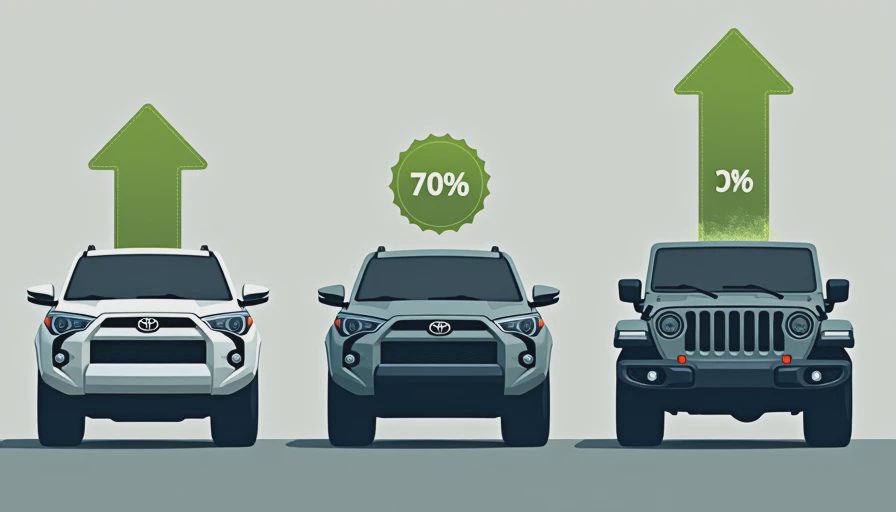
Based on iSeeCars' analysis of over 3 million vehicles and Kelley Blue Book's 2026 awards, here are the midsize SUVs that hold value best:
Rank | Model | 5-Year Retained Value | Above Segment Average |
|---|---|---|---|
1 | Toyota 4Runner | 74.6% | +19.2% |
2 | Toyota Grand Highlander | 69.6% | +14.2% |
3 | Jeep Wrangler | 68.0% | +12.6% |
Toyota 4Runner (74.6% after 5 years).
The 4Runner's resale dominance isn't surprising if you understand what drives it. This is a vehicle built on a body-on-frame platform in an era of unibody crossovers. Its redesign cycle is glacial — the current generation ran largely unchanged for over a decade before its 2025 refresh — which means a three-year-old 4Runner doesn't look dramatically different from a new one. Limited factory incentives keep transaction prices high, and a reputation for 200,000-mile durability keeps used buyers confident. The average price for a 5-year-old 4Runner is $37,406. That's not depreciation. That's a savings account with a V6.
Toyota Grand Highlander (69.6% after 5 years).
The Grand Highlander is a newer nameplate, but it benefits from the same Toyota ownership logic. Strong demand for three-row family SUVs, combined with Toyota's brand-level resale advantage — the automaker averages 53% retained value across its lineup — keeps used prices elevated. For a family buyer who needs the third row, this is one of the safest places to put your money.
Jeep Wrangler (68.0% after 5 years).
The Wrangler is an outlier in the best possible way. Like the 4Runner, it occupies a niche where used demand consistently outstrips supply. Enthusiast culture, off-road capability, and a vast aftermarket ecosystem mean a three-year-old Wrangler with 30,000 miles sells for $27,853 on average — and there's always a buyer waiting. The Wrangler's resale strength is less about practical family math and more about a buyer base that values the Wrangler identity as much as the vehicle itself.
The Other End: Where Money Disappears
Not every midsize SUV ages gracefully. According to iSeeCars data, the five fastest-depreciating midsize SUVs over five years are:
Model | 5-Year Depreciation |
|---|---|
Tesla Model X | 61.2% |
Infiniti QX60 | 58.3% |
Range Rover Sport | 58.3% |
Land Rover Discovery | 57.9% |
Audi Q7 | 57.2% |
Several patterns emerge. Four of the five are luxury-brand vehicles, and luxury SUVs depreciate faster than mainstream models as a rule — higher MSRPs leave more room to fall, and the used luxury buyer is more sensitive to maintenance costs than the new luxury buyer.
The Tesla Model X is its own story. At 61.2% depreciation, it loses more value than any midsize SUV in the segment. The reasons are layered: it's an EV, and EVs as a category depreciate faster than combustion vehicles; it's a luxury vehicle; and Tesla's own pricing history — multiple MSRP cuts followed by increases — has undercut resale values for buyers who purchased during peak-price periods. In early April 2026, Tesla announced it was discontinuing the Model X entirely, which adds another layer of uncertainty for current owners.
What This Means for a 3-Year Decision
If you're planning to hold a vehicle for roughly three years — a common lease-length or early-trade window — resale value isn't theoretical. It's the difference between walking into your next purchase with equity or rolling negative equity into a new loan.
The iSeeCars data and KBB awards both point toward the same practical conclusion: Toyota dominates resale value in the midsize SUV segment, and the gap between the best and worst performers is wide enough to matter. The 4Runner, Grand Highlander, and Highlander all score well above the segment average. If resale is a priority and you're cross-shopping multiple brands, the Toyota premium at purchase tends to come back to you at resale — and then some.
The pragmatic framework for a three-year resale decision:
Check the 36-month residual value before you buy. If you're leasing, the residual is set by the captive finance company and tells you exactly what they think the vehicle will be worth. A higher residual means lower lease payments and a stronger equity position if you buy out the lease.
Avoid buying at the peak of a model cycle. A vehicle that's about to be redesigned will depreciate faster when the new generation hits showrooms. If you're only holding for three years, aim for a model that's early in its cycle — or one like the 4Runner that refreshes so slowly it barely matters.
Limit your exposure to luxury brands if resale matters. The five worst depreciators are all luxury or premium models. If you want a luxury midsize SUV, consider buying one that's already three years old and let someone else absorb the steepest part of the depreciation curve.
The Bottom Line
The question isn't whether your SUV will lose value. It will. The question is how much — and whether you accounted for that when you chose which one to buy.
A $45,000 4Runner and a $45,000 alternative don’t cost the same thing. After three years, the difference in retained value can exceed $5,000. That’s money you either have for your next vehicle or don’t. Don’t buy the sticker price. Buy the long-term number.
Sources: iSeeCars 2026 5-Year Depreciation Study, Kelley Blue Book 2026 Best Resale Value Awards, manufacturer-reported pricing.