
The Chip Cost Surge: What's Actually Happening
The story begins in semiconductor factories, not car factories. Automotive-grade DRAM and NAND flash memory — the chips that process data from radar, cameras, and LiDAR sensors — have seen prices spike dramatically since late 2025. An 8GB automotive DDR4 chip that cost $3.78 at the beginning of 2025 had reached $16.51 by year-end, a 337% increase. DDR5 prices have followed a similar trajectory, with spot market prices more than tripling.
Why? The same memory chips used in advanced driver-assistance systems are also in heavy demand from data centers powering AI applications. Samsung, SK Hynix, and Micron — the three companies that dominate global DRAM production — have prioritized their largest customers. SK Hynix has already sold out its entire 2026 production capacity, and new orders now face lead times exceeding 58 weeks .
The result: a vehicle equipped with LiDAR, multiple cameras, and a high-performance processing unit requires far more memory than a base-model SUV, and that memory now costs dramatically more than it did when the vehicle was designed and priced. Automakers are absorbing some of the increase, but not all of it.
Where the Costs Are Surfacing
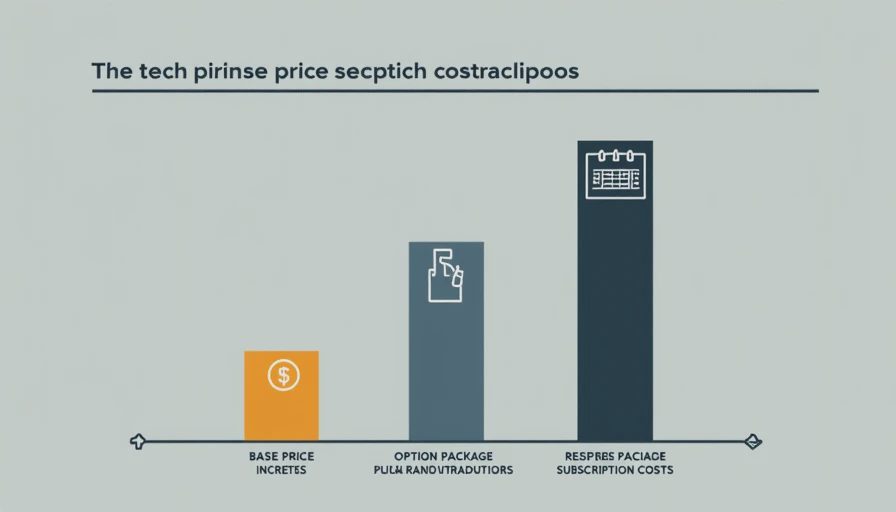
The price pressure is showing up in three distinct ways across the family SUV market.
First, direct price increases on advanced safety packages. BYD raised the price of its "God's Eye B" LiDAR-based driver assistance package by 21% in May 2026, from 9,900 yuan to 12,000 yuan . The official explanation cited "a significant rise in global storage hardware costs." At least 15 automakers have announced similar adjustments, with increases typically ranging from 300 to1,500 depending on the complexity of the system .
Second, the shift from standard inclusion to paid option. Some manufacturers are moving advanced driver-assistance features from standard equipment lists to optional packages. Features that were bundled into higher trim levels are being unbundled and priced separately. This allows automakers to keep base vehicle prices stable while capturing the cost of advanced hardware from buyers who specifically want those features .
Third, subscription models for ongoing software access. Tesla, Xpeng, and Li Auto have all moved toward subscription-based access for their most advanced driver-assistance features . The hardware is installed in the vehicle — you paid for it when you bought the car — but the software that activates it requires a recurring fee. This shifts the cost of ongoing development and cloud computing onto owners, rather than being amortized across all buyers at the point of sale.
The pattern is consistent across markets: basic safety equipment remains standard and affordable, while the most advanced systems — the ones automakers feature in their advertising — are becoming more expensive and less likely to be included in the base price .
What Family Buyers Are Actually Getting
It's worth separating the safety technology that demonstrably reduces injury risk from the technology that primarily serves as a marketing differentiator.
Systems with strong, published evidence of real-world effectiveness:
Automatic emergency braking with pedestrian detection. The IIHS estimates that AEB reduces front-to-rear crashes by 50%, and the technology is now standard on nearly every new SUV sold in the U.S. This is a genuine safety advance, and its cost has been largely absorbed into vehicle pricing over the past decade.
Blind-spot monitoring and rear cross-traffic alert. These are mature technologies with proven effectiveness in preventing lane-change and parking-lot collisions. They are standard on most mid-trim family SUVs and add negligible incremental cost.
Adaptive cruise control. Less about safety and more about driver comfort on long highway drives, but the underlying radar hardware also supports AEB functionality. Standard on most vehicles above base trim.
Systems with less established real-world benefit — and higher costs:
LiDAR-based 3D mapping and hands-free highway driving. These systems represent the cutting edge of driver-assistance technology, but the incremental safety benefit over radar-and-camera-based systems is still being studied. They are also the most sensitive to the memory chip price increases, because processing LiDAR point-cloud data requires substantial onboard computing power .
Over-the-air software subscriptions for advanced driver aids. A vehicle may ship with all the necessary hardware for hands-free driving, but the feature remains locked until the owner pays a monthly or annual fee. This model generates recurring revenue for automakers but creates a scenario where a used car's safety capabilities depend on whether the previous owner maintained a subscription .
The IIHS has noted that several affordable vehicles priced below $30,000 now offer strong crash protection and standard driver assistance — evidence that safety and affordability can coexist when automakers prioritize structural engineering over feature count . The concern, as IIHS researchers have pointed out, is that placing the most advanced protections behind a paywall risks creating a gap between vehicles that are safe and vehicles that are merely expensive.
The Hardware Longevity Problem
There's a second, less discussed cost buried in the safety-tech equation: the risk that today's cutting-edge hardware will be unsupported tomorrow.
When a new vehicle is redesigned around a specific sensor suite and processing platform, owners are betting that the automaker will continue supporting that hardware for the life of the vehicle. That bet doesn't always pay off.
The issue has surfaced most visibly in China, where rapid model cycles have left some buyers with vehicles whose advanced hardware was superseded within a year of purchase. Owners of 2025 model-year vehicles have reported that newly released 2026 versions received upgraded LiDAR sensors and processing chips that rendered the previous generation functionally obsolete for future software updates . While this particular dynamic is most acute in the Chinese market, the underlying dynamic — hardware is advancing faster than automaker commitments to long-term software support — applies anywhere advanced driver-assistance systems are being deployed.
For family SUV buyers in the U.S., the practical question is straightforward: if you pay extra for a LiDAR-equipped trim level today, will the automaker still be updating the software for that specific hardware configuration in 2030? The answer depends on the manufacturer's track record with over-the-air updates, the sales volume of the specific model, and whether the sensor supplier remains a going concern. None of those variables are within the buyer's control.
How to Think About Safety Tech Costs as a Buyer
1. Distinguish between proven safety and marketing features. Automatic emergency braking, blind-spot monitoring, and rear cross-traffic alert have real-world effectiveness data behind them. They're worth paying for, and they're increasingly standard. A LiDAR sensor that enables hands-free highway driving may be valuable to you — but recognize that you're paying for convenience as much as safety, and the cost premium is substantial.
2. Check whether advanced features require a subscription. Before you sign, ask whether the driver-assistance features you're paying for in the purchase price require an ongoing subscription to function. If they do, factor the subscription cost into your ownership budget — and consider what happens to resale value if the next owner doesn't continue the subscription .
3. Consider the support horizon. A vehicle purchased today with a specific LiDAR-and-chip configuration will age differently than a vehicle equipped with more mature, widely deployed sensor technology. The more unique the hardware, the less incentive the automaker has to maintain software support over the long term — especially if the model is a low-volume variant.
4. Run the numbers on the trim ladder. A mid-trim family SUV with radar-and-camera-based driver aids may offer 90% of the safety benefit of a top-trim version with LiDAR at 70% of the cost. Ask yourself whether the incremental technology is worth the difference — and whether that money might be better spent on things that also affect safety, like tires, maintenance, or a second set of winter wheels.
The Bottom Line
The cost of building advanced driver-assistance systems is rising faster than automakers can absorb, and those costs are being passed to buyers — sometimes visibly, in the form of higher option prices, and sometimes invisibly, in the form of features that quietly migrate from standard to optional .
Some of this technology saves lives. Some of it adds cost, complexity, and long-term support risk in exchange for incremental convenience. The distinction matters, and the window sticker doesn't make it for you.
Don't buy the sensor count. Don't buy the marketing name for the driver-assistance package. Buy the features with published, independent evidence of effectiveness — and know that in 2026, the most expensive safety tech isn't always the one that protects your family best. It's just the one that costs the most to build.
Sources: CnEVPost coverage of BYD pricing, Automobile Magazine/Newswheel DRAM and safety tech reporting, S&P Global semiconductor supply data, IIHS analysis of safety technology costs.