

Hybrid SUVs are no longer a niche choice. But the math that determines whether one saves you real money has shifted in 2026. The average hybrid price premium now sits around $4,300, though the range is wide — from roughly $1,600 on some models to over $13,000 on others [citation: 7]. Meanwhile, federal tax credits for plug-in vehicles were repealed in the FY2025 reconciliation law, removing a variable that once tilted the equation [citation: 10]. At the same time, some automakers are actually cutting hybrid prices: the 2026 Subaru Forester Hybrid dropped by over $1,800 compared to the outgoing model year. The result is a break-even landscape that varies more by model than it did two years ago. Here’s how to run the numbers for the SUVs you’re actually considering — and where the math works in your favor right now.
The Hybrid Premium Is Shrinking — But Not for Every Model
The single most important number in the hybrid break-even equation is the upfront price difference between the hybrid and its gas-only equivalent. In 2026, that number has never been more variable.
According to S&P Global Mobility data from February 2026, the average list-price premium for a hybrid over a gasoline-only version of the same model is approximately $4,300 [citation:7]. But the range is enormous — from as little as $1,614 to as much as $13,121. That spread means the answer to “does a hybrid save me money” depends almost entirely on which SUV you’re buying.
Some models have narrowed the gap to the point where the break-even period is under two years. The 2026 Hyundai Santa Fe Hybrid SE, for example, costs just $1,350 more than its gas counterpart. The EPA estimates the hybrid saves $850 per year in fuel at 15,000 miles driven annually. That’s a payback in roughly 19 months. The 2026 Hyundai Palisade Hybrid follows a similar pattern — roughly a two-year break-even for a three-row family SUV.
Then there are models where the hybrid premium remains stubbornly high. The Honda Civic Hybrid costs $2,700 more than a comparable gas Civic, yet the EPA-estimated annual fuel savings is just $450 — a six-year break-even timeline. For a buyer who trades out of a vehicle in three to five years, that math doesn’t close.
The practical takeaway: Don’t assume “hybrid = saves money” as a blanket rule. The break-even math is model-specific. Before you shop, compare the MSRP difference between the hybrid and gas versions of the exact trim you want — and run the fuel-cost numbers. The EPA’s fuel economy comparison tool makes this straightforward .
The Forester Anomaly — And What It Signals
One data point in 2026 deserves attention because it breaks the historical pattern: Subaru cut the 2026 Forester Hybrid’s starting price by over $1,800 compared to the 2025 model year, bringing the Premium Hybrid trim to $34,730.
This matters because it’s a reversal of the industry’s long-standing assumption that hybrids command a premium. The Forester Hybrid now starts under $35,000 while delivering up to 40% better city fuel economy and an EPA-rated total range of 581 miles — 100 miles more than the gas version . For a family buyer, that’s not just a break-even question. It’s an upfront affordability question where the hybrid makes a stronger case on purchase price alone.
Whether other automakers follow Subaru’s lead is an open question. But the Forester example suggests the hybrid premium is not an immutable law. As hybrid production scales and more models enter the market, price gaps may continue to compress on competitive nameplates.
The Fuel Math: How to Calculate Your Actual Break-Even
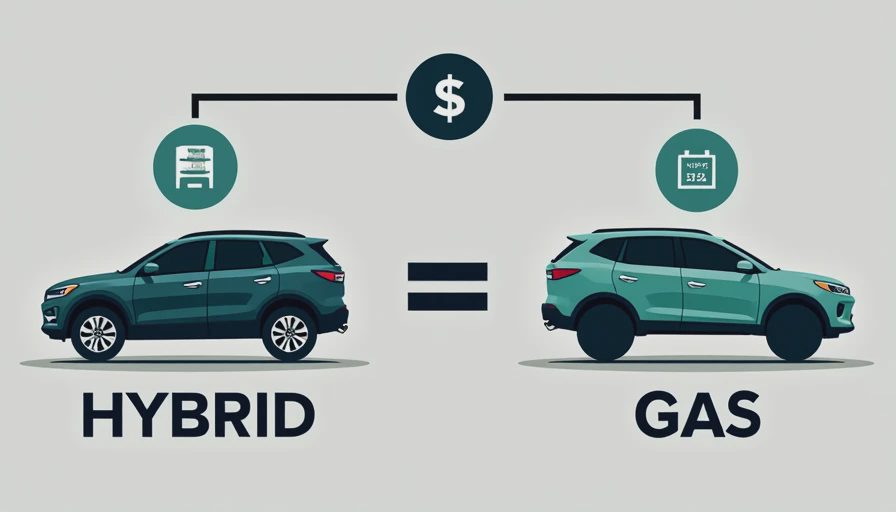
Here’s the formula that matters. It’s simple enough to run on your phone while standing in a dealership:
Step 1: Find the price difference between the hybrid and gas versions of the same SUV, in the same trim level.
Step 2: Estimate your annual fuel cost for each. Take your expected annual mileage, divide by the combined MPG for each vehicle, and multiply by your local gas price. Or use the EPA’s fuel economy website, which does this math for you .
Step 3: Divide the price premium (Step 1) by the annual fuel savings (the difference between the two results in Step 2). The result is your break-even point in years.
Example using 2026 data:
Vehicle: Hyundai Santa Fe Hybrid SE vs. gas Santa Fe SE
Price premium: $1,350
Annual fuel savings: $850 (at 15,000 miles/year, per EPA estimates)
Break-even: 1.6 years
Vehicle: Honda Civic Hybrid vs. gas Civic
Price premium: $2,700
Annual fuel savings: $450
Break-even: 6 years
If you plan to own the vehicle for longer than the break-even number, the hybrid saves you money. If you trade out sooner, the gas version was cheaper overall. It’s not about whether hybrids are “worth it” in the abstract. It’s about whether the math closes during your ownership window.
The Tax Credit Variable Is Gone — For Now
A factor that changed the 2026 equation: the federal clean vehicle tax credits created by the Inflation Reduction Act were repealed in the FY2025 reconciliation law . The $7,500 credit that once applied to qualifying plug-in hybrids and EVs — and, in some cases, could be transferred to the dealer for an upfront price reduction — is no longer available for purchases after the repeal took effect .
For hybrid shoppers, this matters less than it does for EV buyers, since most conventional hybrids (non-plug-in) weren’t eligible for the credit in the first place. But if you were cross-shopping a plug-in hybrid like the 2026 Toyota RAV4 Plug-in Hybrid — which starts at $42,950 with 52 miles of all-electric range — against a conventional hybrid, the credit’s absence removes a variable that previously tilted the math toward plug-in models .
Where the Break-Even Math Works Best Right Now
Based on 2026 data, here are the hybrid SUVs where the numbers close fastest for family buyers:
Model | Est. Hybrid Premium | Est. Annual Fuel Savings | Approx. Break-Even |
|---|---|---|---|
2026 Hyundai Santa Fe Hybrid | ~$1,350 | ~$850 | ~1.6 years |
2026 Hyundai Palisade Hybrid | ~$1,500–2,000 | ~$1,100 | ~2 years |
2026 Subaru Forester Hybrid | Price drop vs. 2025 | 40% better city MPG | Shorter than typical |
2026 Toyota Grand Highlander Hybrid | ~$2,000–3,000 | Varies | ~2 years |
These numbers come from EPA estimates, manufacturer data, and Edmunds analysis . They assume 15,000 miles driven annually. Your mileage — literally and financially — will vary based on your driving habits and local fuel prices.
Sources in this article draw from EPA fuel economy data, S&P Global Mobility retail inventory analysis, Edmunds, and manufacturer-reported pricing . Federal tax credit information is based on the Congressional Research Service summary of the FY2025 reconciliation law .
The Bottom Line
The question isn’t whether hybrids save money. It’s whether the specific hybrid you’re considering saves money during the time you plan to own it.
In 2026, the answer skews more toward “yes” than it did three years ago. Price premiums are compressing on competitive models. Some automakers are cutting hybrid prices outright. And fuel prices remain high enough to make the annual savings real. But the range of outcomes is wide, and a hybrid that makes financial sense for a 15,000-mile-per-year driver may not close for someone who drives half that.
Run the break-even math on the exact trim you want. Don’t buy the hybrid badge. Buy the numbers.